Sympatry mapping techniques map the modern regions of habitation for animals found at an archaeological site, to discover what areas the majority of species may be found in today. For example, if five species were discovered at a certain site, and their ranges were mapped over each other, the area where most or all of the species' modern ranges overlap is the area of maximum sympatry. This mapping can reveal useful information about paleoclimates. Small mammals are especially sensitive to alterations in microclimate, moisture, and temperature, and tend to thrive under very specific conditions. A collection of animal ranges may reflect a narrow climatic band. By finding the area of maximum sympatry today, we can extrapolate the climate of a site several hundred or thousand years ago. For example, in a radical case of sympatry, the site might lie completely outside the area of maximum sympatry. If the area of maximum sympatry is to the north of the site, in terrain that is drier and cooler than the region the site is in today, then archaeologists may consider the site to have been colder and drier at the time it was deposited (Graham and Semken 1987:7- 8).
For this study, the author collected faunal data on six Woodland Tradition and Central Plains Tradition sites in Nebraska, Iowa, and Kansas, and applied sympatry mapping techniques to the results. The six sites studied are: the Hulme Site (25HL28), a Central Plains Tradition site in Hall County, Nebraska; the Packer Site (25M9), a Late Woodland Tradition site in Sherman County, Nebraska; the Palmer Johnson Site (25BU37), a Central Plains Tradition site in Butler County, Nebraska; all four horizons of the Rainbow Site (13PM91), Middle to Late Woodland site near Hinton, Iowa ; the Wallace Site (25GO2), a Middle Woodland site in Gosper County, Nebraska; and the Witt Site (14GE600), a Central Plains Tradition site in Central Kansas.
The six sites under consideration in this study were in habitation from AD 250 to AD 1350, following the warm and dry Atlantic Climatic Episode, which ended approximately 5000 years ago. Faunal and pollen analytic studies reveal that the Post-Atlantic Episodes since this time have seen a series of small climatic fluctuations, as climates across the plains and North America became increasingly more like modern climates (Wedel 1986:39- 43; Wendland, et al. 1987:466- 469). Immediately following the Atlantic Episode was the Sub-Boreal Episode, a period of cool, dry conditions stretching from BC 3000 to BC 950, nearly 1000 years before the earliest sites considered here. Climates became wetter overall in the Sub-Atlantic episode, lasting until approximately AD 300, but returned to warmer and drier conditions for a short period in the Scandic Episode until AD 700. Climates became more moist again for a short period in the Neo-Atlantic, which lasted until AD 1150, but droughtlike conditions began to return to the plains around AD 850, which dominated the continent during the Pacific episode from AD 1150 to AD 1550. The very dry Pacific episode has been cited as a causal factor in the reorganization of subsistence patterns on the plains. Stable agricultural patterns became less prevelant throughout the central plains, shifting to seasonal horticulture in most places, and disappearing altogether in western Nebraska and Kansas and eastern Colorado. Following the Pacific Episode was the Neo-Boreal Episode, from AD 1550 to slightly more than 100 years ago, marked by colder, moister climates in a period known as the "Little Ice Age." Conditions since this time have generally resembled those of today. (See Table 1 for a summary of Post-Atlantic Episodes).
Climatic Episode  Summary of Climate                 Approx. Dates
----------------  ------------------                 -------------
Sub-Boreal        Dryer, cooler in northern plains.  BC 3000-950
Sub-Atlantic      Summers wetter, winters possibly   BC 950-AD 300
                    stormier.
Scandic           General return to Atlantic con-    AD 300-700
                    ditions: warmer and drier.
Neo-Atlantic      Continued warmth, increased        AD 700-1150
                    moisture. Increasingly drought-
                    like conditions beginning ca.
                    AD 850, in northeastern plains.
Pacific           Droughtlike conditions intensify;  AD 1150-1550
                    seasonally dry air and cooler
                    with decreased preciptation
                    year-round.
The species chosen for this study include any rodent, insectivore, or lagomorph roughly smaller in mass than a rabbit which can be considered a good indicator of paleoclimate.
From the six sites under study, fifteen species were positively identified (with each site averaging seven identified species), and are considered in this study. Specimens where only the family or genus is known, or where their specific classification is unknown, were deemed too uncertain to determine ranges and were not considered. (See Table 2 and Table 3 for a complete list of species and sites studied.)
Latin Name                Common Name                 Family       Sites
----------                -----------                 ------       -----
Blarina carolinensis      Southern Short-tailed Shrew Talpidae     1
Citellus franklinii       Franklin's Ground Squirrel  Sciuridae    1,2,3,4
Citellus tridecemlineatus 13-lined Ground Squirrel    Sciuridae    1,2,4
Cynomys ludovicianus      black-tailed prairie dog    Sciuridae    1,2,5
Geomys bursarius          plains pocket gopher        Geomydae     2,3,4,5,6
Microtus ochrogaster      prairie vole                Cricetidae   1,4,6
Microtus pennsylvanicus   meadow vole                 Cricetidae   3,5
Neotoma floridana         eastern wood rat            Cricetidae   6
Onychomys leucogaster     northern grasshopper mouse  Cricetidae   2,3,5,6
Oryzomys palustris        marsh rice rat              Cricetidae   3,6
Perognathus hispidus      hispid pocket mouse         Heteromyidae 2,5,6
Scalopus aquaticus        eastern mole                Cricetidae   5
Sciurius niger            fox squirrel                Sciuridae    4,5,6
Sylvilagus floridanus     eastern cottontail          Leporidae    1,2,3,4,6
Synaptomys cooperi        southern bog lemming        Cricetidae   4
Site                    Pd. (AD)   Cultural Affiliation Climatic Episode
----                    --------   -------------------- ----------------
Hulme (25HL28)          1175-1225  Central Plains       Pacific
Packer (25M9)           980-1050   Late Woodland        Neo-Atlantic
Palmer Johnson (25BU37) 1275-1300  Central Plains       Pacific
Rainbow (13PM91)        250-675    Mid Late Woodland    Sub-Atlantic--Scandic
Wallace (25GO2)         425-650    Middle Woodland      Scandic
Witt (14GE600)          1250-1350  Central Plains       Pacific
The modern range of each species represented at a site was mapped on a single transparent overlay, and all the overlays representing the assemblage of small mammals recovered were laid one over another. The area with the greatest overlap of small animal ranges is the area of maximum sympatry. In most cases, this area corresponds to the overlap of all species recovered at a site, but in some cases certain species were found in their modern habitats outside the area of maximum sympatry. These are unusual cases, and have been noted.
Unless otherwise noted, basic data concerning ranges and habitats were obtained from Peterson's Field Guide to the Mammals, with corroboration from Mammals of the Northern Great Plains.
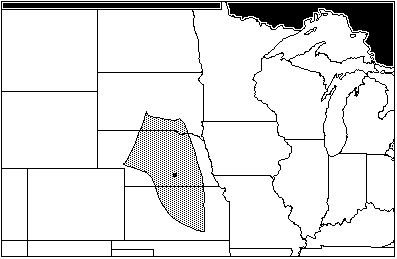
The oldest site, Rainbow, in northwestern Iowa, also has the longest record of habitation. It contains four cultural horizons dating from AD 250 to AD 675. (Falk & Semken 1990: 145 164.) The Rainbow assemblage from all four horizons included: Sylvylagus floridanus, the eastern cottontail; Citellus tridecemlineatus and Citellus franklinii, the thirteen-lined ground squirrel and Franklin's ground squirrel; Sciurius niger, the fox squirrel; Geomys bursarius, the plains pocket gopher; Synaptomys cooperi, the southern bog lemming; and Microtus ochrogaster, the prairie vole. The area of maximum sympatry for all four horizons is fairly large, stretching north into northwestern Minnesota, west to the Nebraska panhandle, south to the Ozarks of Missouri, and along the Mississippi. G. bursarius defines the eastern border of the area of maximum sympatry-- generally along the Mississippi River, with a projection into central Illinois and Indiana (Figure 1). All seven of the species are found in this area. The assemblage is dominated by eastern fauna, many of which live in wooded or marshy settings (i.e. Sciurius niger, Sylvilagus floridanus, and Synaptomys cooperi.) The others, however, show a favoritism towards open or meadow settings.
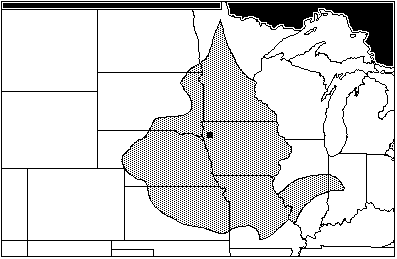
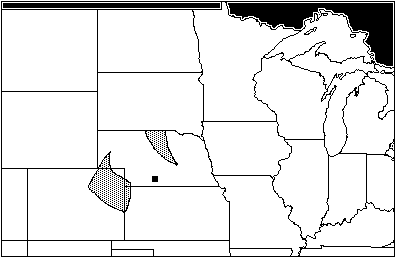
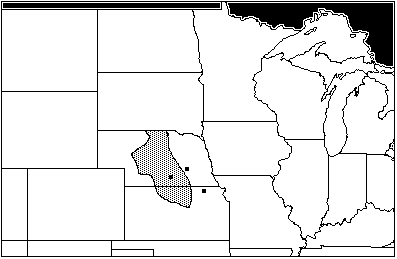
The next oldest site of the Woodland affiliation is the Wallace site, in Gosper County, Nebraska, near the Kansas border, and dates from AD 425 to 650. (Bozell & Koch n.d.) The Wallace assemblage includes: Scalopus aquaticus, the eastern mole; Cynomys ludovicianus, the blacktail prairie dog; Sciurius niger; Perognathus hispidus, the hispid pocket mouse; Onychomys leucogaster, the northern grasshopper mouse; Microtus pennsylvanicus, the meadow vole; and Geomys bursarius. There are two small areas of maximum sympatry for the Wallace site, one a sliver of north-central Nebraska running south from the Niobrara river, the other a small wedge in extreme northeastern Colorado (Figure 2). This unusual sympatry is caused by the distribution of Microtus pennsylvanicus, a vole with an affinity for open habitats near water. Today, M. pennsylvanicus is absent from much of Nebraska, including Gosper county. The secondary area of sympatry without M. pennsylvanicus runs along the Niobrara river in the north, south through Nebraska, Kansas and Oklahoma into central Texas (Figure 3). Sciurius niger is the only species of the Wallace assemblage with affinities for woodland habitats; the rest show a definite preference for open, sparsely-vegetated habitat.
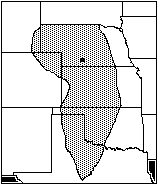
The Packer Site, in Sherman County, Nebraska, is the most recent Woodland site, dating to the Great Oasis Phase of the Late Woodland Tradition (ad 980 1050) (Bozell and Rogers 1989:3- 36). The Packer assemblage includes: Sylvilagus floridanus, the eastern cottontail; Citellus franklinii; Citellus tridecemlineatus; Cynomys ludovicianus; Geomys bursarius; Perognathus hispidus; and Onychomys leucogaster. The area of maximum sympatry includes all seven of the species, and occupies central Nebraska, extending north into South Dakota, and south into Kansas (Figure 4). All of the species show a marked affinity for low vegetation, short- and long-grass prairie habitats, except for Sylvilagus floridanus. S. floridanus is often considered a woodlands rabbit, but can adapt readily to any low-altitude habitat with adequate ground cover.
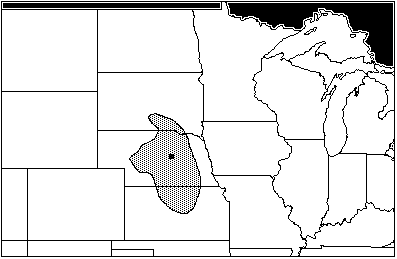
Taken together, the collected assemblage for the Woodland traditions sites have no area of total maximum sympatry, owing to the unusual modern distribution of Microtus pennsylvanicus. Excluding M. pennsylvanicus leaves an area of sympatry in central Nebraska, extending south into Kansas (Figure 5).
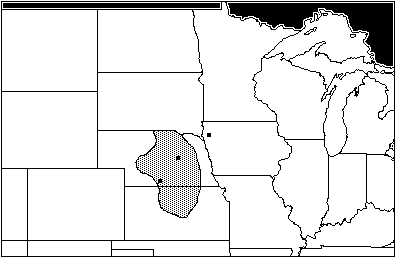
The Hulme Site, in Hall County, Nebraska, dates to ad 1175 1225. (Bozell 1991:229- 253). Its assemblage contains: Blarina carolinensis, the southern short-tailed shrew; Sylvilagus floridanus; Citellus franklinii; C. tridecemlineatus; Cynomys ludovicianus; Geomys bursarius; and Microtus ochrogaster. The site lies in nearly the center of the area of maximum sympatry, which runs from southern South Dakota through Nebraska and into Kansas (Figure 6). This assemblage represents a variety of habitats, with Plains animals (Citellus tridecemlineatus, Cynomys ludovicianus); mixed-habitat animals (Citellus franklinii); and woodland animals (Blarina carolinensis, Sylvilagus floridanus), although these last three are unparticular animals.
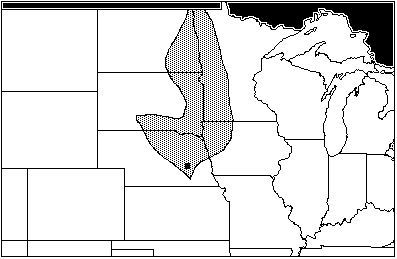
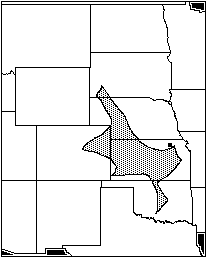
The collected sympatry data for all species at Central Plains Tradition sites yields no area of total maximum sympatry, owing to O. palustris. Excluding O. palustris from the data set reveals an area of sympatry covering central Nebraska, extending south into Kansas (Figure 9). This is very similar to the area of maximum sympatry for Woodlands sites, which has implications for the severity of climatic change between the Neo-Atlantic and Pacific episodes ("Conclusions," below).
Second, the level to which these small animals have been affected by human habitation is poorly-understood. These are small and unglamorous creatures, and subsequently not the subject of much study. A few, such as the blacktail prairie dog (Cynomys ludovicianus) and the plains pocket gopher (Geomys bursarius) have been actively hunted or exterminated as pests in many parts of their original ranges. Some species, such as the fox squirrel (Sciurius niger), have thrived in and near urban and suburban habitats, while others, such as the northern grasshopper mouse (Onychomys leucogaster) have faced serious competition from introduced species like the house mouse (Mus musculus).
Third, it is unknown to what level these animals were exploited by humans for food resources. Ethnohistoric records indicate that the larger animals, such as the blacktail prairie dog (Cynomys ludovicianus), were probably used as food by the Omaha, the Pawnee, the Kansa, and other groups; the eastern cottontail (Sylvilagus floridanus) almost certainly was. That these were procured animals has implications for there presence at an archaeological site: just how far would a band of foragers transport rabbits and prairie dogs for food?
Fourth, it is uncertain to what degree some of these animals are intrusive. Certainly, burrowing species such as the eastern mole (Scalopus aquaticus) and the plains pocket gopher (Geomys bursarius) may have intruded into the cache pits and midden pits that were later excavated, and foraging species, such as the hispid pocket mouse (Perognathus hispidus) are probably also not directly associated with the deposition of the artifacts. The question becomes, then, at what time after deposition did these animals intrude? Certainly, there would be no incentive for a mouse to enter a cache pit for food several years after it was abandoned; the food would have decayed by this time. It is entirely likely that most of these animals entered the present-day site within a few decades after deposition, since it is during this time that soil was softest for burrowing, and the proverbial scraps from the humans' tables were still fresh. Moreover, these species, often considered intrusive, may have been used as a food source (Falk and Semken 159- 162).
Equally as interesting, however, is the comparison of the total sympatric area of all three Woodland Tradition sites, as compared to the total sympatric area for all three Central Plains Tradition sites. Although these maps represent spans of centuries on either side of the transition from the Neo-Atlantic to the Pacific episodes, they are nearly identical, implying that small fauna were not generally affected by the climatic shift.
This in and of itself, however, evokes intriguing possibilities. The Middle Woodland to Central Plains Traditions period encompasses an important era in Plains prehistory: namely, the spread of agriculture through the Plains after the Atlantic Episode, followed by its abandonment in the dry Pacific Episode. That humans may have been evidencing adaptations to climatic changes that left small mammal unaffected says something of both the resilience of humans and the fragility of cultural systems. As a species, we may be more successful and adaptive than any of these fifteen small mammals, but our cultural systems may not be. Very slight changes in microclimate may force ever-widening rings of change in economic strategies, affecting social structure, information networks, and technology.
Modern humans have forgotten how intricately their cultural systems are tied to the natural environment. If climatic shifts so slight as to leave mice and voles unaffected caused a wave a change across the prehistoric Plains, how could global warming, species and ozone loss, and depletion of resources affect modern culture?
At the same time, archaeologists should turn their attention to animal ethology, to gain a better understanding in animal behavior. Knowing how animals behave in and around recently-deposited cultural remains will help to clear up questions regarding post-depositional intrusions. If we can understand how small animals come to be found in an archaeological site, then we can reach more accurate conclusions as to what their presence implies.
![[index]](../images/atom.gif)
![[words]](../images/tv.gif)
![[tourist]](../images/world.gif)
![[links]](../images/rocket.gif)
![[info]](../images/info.gif)
![[email]](../images/at.gif)